

My friend spent three months planning his “online business.”
He researched LLCs, designed a logo, wrote a 20-page business plan, and created spreadsheets projecting income he hadn’t earned yet. He bought a domain, paid for hosting, and started building a website.
Three months in, he’d made exactly $0.
Meanwhile, another friend signed up for a paid research study on a Tuesday, spent 45 minutes talking about his grocery shopping habits on a video call Thursday, and got paid $75 on Friday.
Same three-day span. One person overthinking, one person earning.
That’s the difference between treating online income like it needs to be this massive undertaking versus just starting something small and real this weekend. You don’t need a business plan. You don’t need special skills. You just need to pick one simple method and actually do it.
What Makes These Methods Different

Most “make money online” lists give you the same recycled ideas. Start a blog (wait 18 months for traffic). Become a freelancer (compete with thousands). Launch a YouTube channel (buy equipment, learn editing, pray for views).
The methods I’m sharing here are different because they meet four specific criteria:
Low barrier to entry. You can start with what you already have. No expensive equipment, no advanced skills, no huge time investment upfront.
Quick setup. We’re talking hours, not months. You can go from “I’ve never heard of this” to “I just applied for my first gig” in a single afternoon.
Legitimate platforms. These aren’t sketchy sites that might disappear next week. They’re established platforms that actually pay people.
Small but real income potential. You’re not going to make $10,000 your first month. But $50-300 in your first few weeks? Totally possible.
Think of these as confidence builders. They prove to you that making money online actually works before you commit to anything bigger or more complex.
Method 1: Paid Research Studies That Actually Pay Well
Here’s something most people don’t know exists. Companies pay real money for your opinions, but not through those garbage 50-cent survey sites. I’m talking about platforms that pay $25 to $200 per hour for research sessions.
How it works:
Researchers need feedback from specific types of people before launching products, services, or features. You fill out a profile, they match you with studies, you join a video call or answer questions, and you get paid.
Best platforms to start:
User Interviews pays $50-200 per session, usually 30-60 minutes. Studies happen over Zoom or phone calls.
Respondent focuses on professional insights but also has consumer studies. Similar pay range.
Prolific has more frequent but lower-paying studies, usually $8-15 per 20-30 minutes.
Real example:
I did a study about online banking for $100. It took 45 minutes. They asked about my habits, what frustrates me, what features I wish existed. That’s it. No special knowledge required, just honest answers.
Quick-start checklist:
Sign up on all three platforms (takes 30 minutes total). Fill out your profile completely and honestly. Check for available studies daily, ideally morning and evening. Apply fast because good studies fill up quick. Show up on time and give thoughtful answers.
You won’t qualify for every study. That’s normal. But qualifying for 2-3 per month can easily add $150-300 to your income with just a few hours of work.
Method 2: Selling Simple Digital Downloads

If you can use Canva (the free version), you can make money selling digital downloads. No design degree needed.
What people actually buy:
Budget trackers and savings planners. Daily routine templates. Meal planning sheets. Study guides and note-taking templates. Quote prints and wall art. Workout logs. Habit trackers.
The key is solving one small, specific problem. Don’t try to make “everything.” Pick one category and make 5-10 variations of it.
Where to sell:
Etsy is the easiest start. Millions of buyers already browsing. You pay 20 cents to list each item, then a small fee when it sells.
Creative Market if your designs are more polished. Higher prices, more selective buyers.
Payhip if you want to avoid marketplace fees. You keep more profit but have to drive your own traffic.
Real example:
Someone I know made a simple budget template in Canva. Clean layout, easy to fill in, nothing fancy. Listed it on Etsy for $3. Sold 40 copies the first month. That’s $120 for maybe three hours of work total.
She’s since made 15 more templates, all variations on the same theme. Now she averages $300-400 per month, all passive income after the initial creation.
Small tip that matters:
Focus on one niche instead of trying to appeal to everyone. “Budget templates for college students” beats “budget templates for everyone.” Specific wins.
Method 3: Voiceover Work You Can Do From Your Closet

If you have a decent speaking voice and a quiet space, you can get paid to record voiceovers. No professional studio needed.
What you actually need:
A quiet room (a closet full of clothes works great for sound dampening). A halfway decent microphone ($30-50 USB mic is fine to start). Free recording software like Audacity or GarageBand.
That’s it. You don’t need soundproofing foam or a $500 setup.
Types of gigs available:
YouTube video intros and outros (30 seconds, pays $10-30). Explainer video narration (2-5 minutes, pays $50-150). Audiobook narration (longer term, pays per finished hour). Phone system recordings (“Press 1 for sales”). Commercial and ad voiceovers.
Where to find work:
Voices.com has a free tier to start. You bid on projects that match your voice type.
Fiverr lets you create a profile and set your own rates. Start low to build reviews, then raise prices.
Upwork has voiceover gigs mixed in with other freelance work.
Quick reality check:
Your first few gigs will probably pay less than you’d like. That’s how you build reviews and samples. Once you have 5-10 completed projects, you can charge more and be selective.
Someone with a normal voice, no special training, can realistically make $200-500 per month doing this part-time once they get rolling.
Method 4: Getting Paid to Review Music or Test Products

This one sounds too simple to be real, but it is. Companies pay people to listen to new music, test websites, or review products and give feedback.
For music reviews:
Slicethepie pays you to review songs before they’re released. You listen to 90 seconds, write a short review, earn 10-20 cents per song. It adds up if you do it while doing other things.
For product and website testing:
UserTesting pays $10 per 20-minute test. You visit a website or app, complete tasks while talking through your thought process, and get paid.
InboxDollars pays for surveys, videos, and small tasks. Lower pay but very easy.
PlaytestCloud pays you to test mobile games and give feedback.
Realistic income:
This is not going to replace a job. It’s more like $20-100 per month of genuinely easy side money you can earn while half-watching TV or between other tasks.
Why this matters more than the money:
I tried Slicethepie for a week just to test it. Made $18 listening to indie music while doing laundry. Not impressive money, but it was the first time I’d ever earned anything online. That $18 proved to me that this whole “make money on the internet” thing wasn’t just for tech gurus or influencers. It worked for regular people too.
That mental shift is worth more than the dollars, especially when you’re just starting.
Method 5: Selling Your Class Notes or Study Materials

I know I’ve mentioned this one a couple times already, but it really is worth repeating. Sorry if you’re tired of hearing about it, but honestly, it’s one of the easiest ways to start making money online if you’re in school or recently graduated.
If you’re in school or recently graduated, you’re sitting on a money-making asset you probably don’t even think about. Your notes.
How this works:
Students who missed class, need extra study help, or want a different perspective on material will pay for well-organized notes and study guides.
Platforms like Stuvia, EduBirdie, and Nexus Notes connect note sellers with buyers. You upload your materials, set a price (or the platform sets it), and earn money when someone downloads them.
What makes notes worth buying:
Clean layout with clear headers and sections. Key concepts highlighted or summarized. Examples and explanations beyond just what the professor said. Organized by topic or chapter. Typed, not handwritten (usually).
Real numbers:
Most notes sell for $3-10 depending on length and subject. Popular classes (intro courses, core requirements) sell more frequently. One semester of good notes from 3-4 classes could earn $200-500 if you keep uploading and people keep buying.
Pro tip:
Take notes with the intention of selling them. That slight mindset shift makes you organize better, which helps you study better anyway. You’re doing the work regardless, might as well get paid for it.
Quick Comparison: Time, Pay, and Skills
Here’s how these five methods stack up:
Paid Research Studies
- Time to start: 1-2 hours (sign up and profile)
- Potential monthly income: $150-300
- Skills needed: None, just honest opinions
- Best for: People comfortable talking on camera
Digital Downloads
- Time to start: 3-5 hours (create first product)
- Potential monthly income: $100-400 (grows over time)
- Skills needed: Basic Canva or design skills
- Best for: Organized, detail-oriented people
Voiceover Work
- Time to start: 2-4 hours (setup and first gig)
- Potential monthly income: $200-500
- Skills needed: Clear speaking voice, quiet space
- Best for: People comfortable with their voice
Review Work
- Time to start: 30 minutes (quick signups)
- Potential monthly income: $20-100
- Skills needed: Ability to follow instructions
- Best for: Anyone wanting super easy entry
Selling Notes
- Time to start: 1-2 hours (format and upload)
- Potential monthly income: $100-300
- Skills needed: Good note-taking habits
- Best for: Current students or recent grads
None of these will change your life overnight. But any one of them can prove that making money online actually works, which changes everything.
Pick based on what sounds least annoying to you, not which pays the most. If you hate something, you won’t stick with it long enough to see results.
Turning Small Starts Into Bigger Income
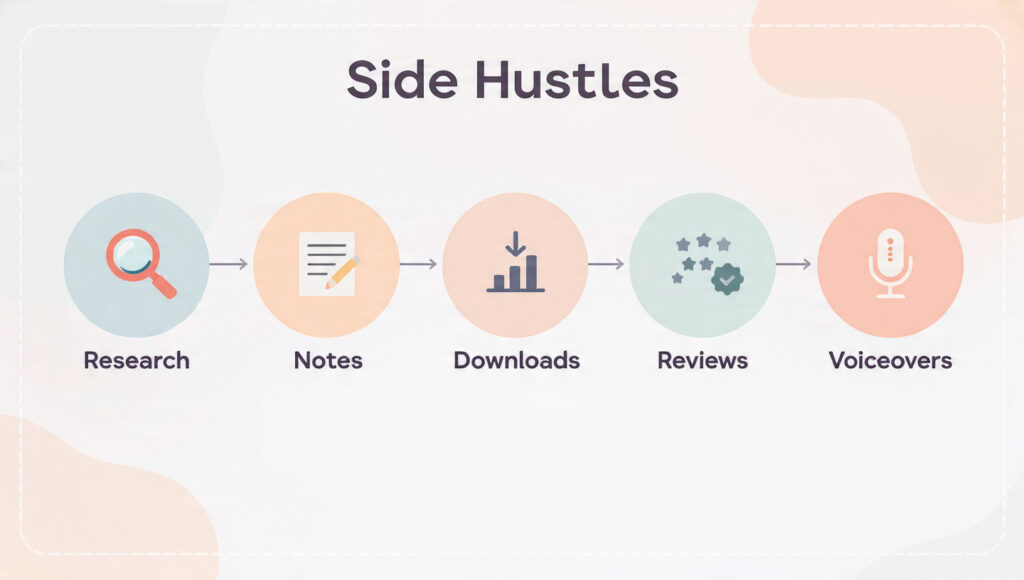
Here’s what most people miss about these methods.
None of them will make you rich by themselves. That’s not the point.
The point is proving to yourself that making money online is real, doable, and not as complicated as the gurus make it sound.
Once you make your first $50, something shifts. You stop wondering “can I actually do this?” and start asking “what else can I do?”
That’s when things get interesting:
Someone doing voiceover work realizes they could narrate audiobooks or create online courses. Someone selling digital downloads learns they could build a full Etsy shop or create templates for other creators. Someone doing paid studies gets comfortable on camera and starts making user-generated content for brands.
Small wins open doors to bigger opportunities. But you have to get the first win first.
Your Move: Pick One and Start This Weekend

Here’s what I want you to do. Not next month. Not when you have more time. This weekend.
Pick one method from this list. The one that sounds least terrible or most interesting. Set a timer for two hours. In those two hours, sign up for the platform, set up your profile or create your first piece, and complete or apply for your first gig.
That’s it. Two hours to go from “I’m thinking about making money online” to “I just took the first actual step.”
Will you make $500 this weekend? Probably not. But you might make $10, $30, maybe $50. And that’s proof. Proof that you can do this. Proof that it’s not all scams and hype.
If you’re not sure which method fits you best, take the Side Hustle Picker Quiz. It’s quick, practical, and will point you to the 1-2 options that match your skills and situation.
Because the hardest part isn’t doing the work. It’s choosing where to start and actually starting instead of thinking about starting for another three months.
You’ve got this weekend. Two hours. One method. Just start.
