

Last semester, my roommate tried to make money online three different times.
First, he spent two weeks setting up a dropshipping store. Learned Shopify, found products, wrote descriptions. Made zero sales. He stared at the empty dashboard for three days before giving up. Then he tried starting a YouTube channel about gaming. Bought a microphone, edited five videos, got 47 total views. Finally, he tried freelance writing on Fiverr. Created a profile, undercut everyone on price, landed one $15 job that took him four hours.
By month three, he was back to applying for regular jobs, convinced the whole “make money online” thing was a scam.
Here’s the thing. None of those ideas were scams. They just weren’t right for him. He’s an introvert who hates being on camera, he’s not a natural writer, and he has zero interest in customer service or marketing. He picked popular side hustles instead of the right side hustle.
That’s what this article is about. How to choose an online side hustle that actually fits you, so you don’t burn three months and your motivation on something that was never going to work in the first place.
The Right Side Hustle Is Different for Each Person

Most articles list the “10 best side hustles” like everyone should do the same things. That’s useless advice.
You can save yourself months of frustration by matching your side hustle to who you are, not who the internet says you should be.
What works for an organized, detail-focused person will drive a creative, spontaneous person crazy. What fits someone with 15 hours a week won’t work for someone with three. And what excites someone who loves talking to people will bore someone who prefers working alone.
The best online side hustle for you depends on four things:
- Your actual skills and strengths. Not the ones you wish you had. The ones you already use without thinking about it.
- How much time you can realistically give. Not “I’ll wake up at 5 a.m. and hustle” fantasy time. Actual, sustainable, this-won’t-make-me-miserable time.
- How fast you need money. Some methods pay within days. Others take months to build. Both are fine, but you need to know which you’re choosing.
- Your comfort with different types of work. Some people love research. Some love creating. Some love systems and organization. Pick the one that doesn’t feel like pulling teeth.
Here’s what that looks like in practice:
Someone detail-oriented and patient thrives with paid research studies, data collection, or analyzing content sites to flip.
Someone creative does better with user-generated content, digital design work, or building templates and printables.
Someone systematic and organized might excel at licensing digital assets, running subscription boxes, or flipping domain names.
The method matters less than the match.
Ask These Questions Before You Pick Anything

Before you commit to any side hustle, work through these five questions. Write down your answers. Seriously, grab a notebook or your phone and write them down.
How many hours per week can I give this without hating my life?
Be honest. If you’re working full time or in school, you probably have 5–10 hours max. That’s fine. Some side hustles fit that. Some don’t.
Do I want active income or passive income?
Active means you work, you get paid. Stop working, money stops. Think freelancing, research studies, or UGC creation.
Passive means you build something once and it keeps earning. Think licensing digital assets, selling templates, or renting unused resources.
Neither is better. Just different trade-offs.
What skills or hobbies can I turn into money?
You’re already good at something. Maybe you take great notes in class. Maybe you’re organized and love making spreadsheets. Maybe you’re comfortable on camera. Start there instead of learning something completely new.
How quickly do I need to see results?
If you need money next month, don’t pick something that takes six months to build. If you’re fine playing the long game, passive options become more attractive.
What sounds least miserable to me?
This matters more than people admit. If you hate writing, don’t become a freelance writer just because some article said it’s “easy.” You’ll quit in three weeks.
Once you have answers, you can eliminate 80 percent of options immediately and focus on the 20 percent that might actually work for you.
Treat New Ideas Like 30-Day Experiments
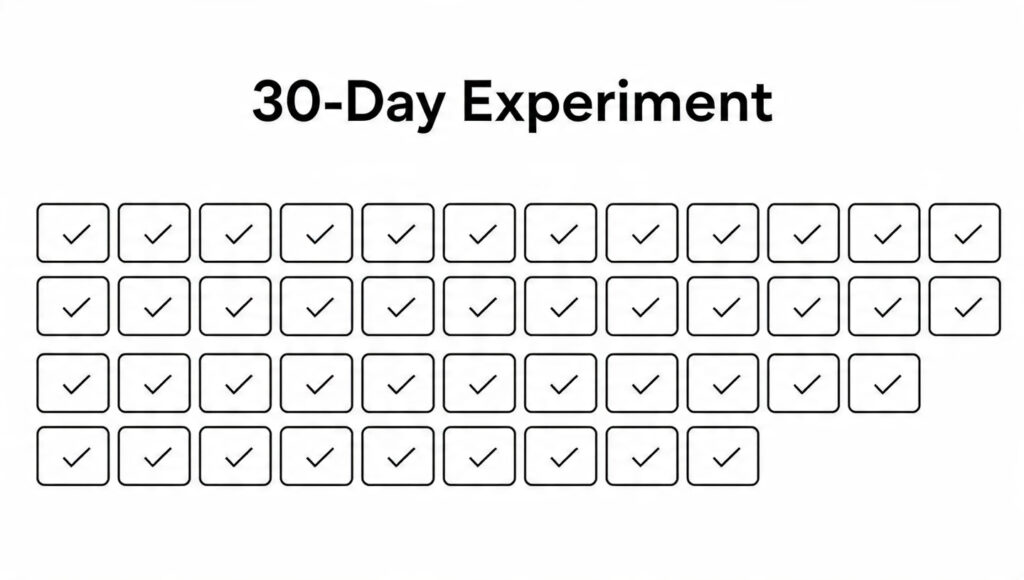
Here’s how to test a new idea without overthinking it.
My roommate treated each side hustle like a major life decision, something he had to fully commit to before knowing if it would work. That’s backward.
Instead, treat each idea like a 30-day experiment. Give it one month of honest effort, track what happens, then decide if it’s worth continuing.
Week 1: Setup and Learning
Research the basics. Set up accounts or profiles. Learn the minimum needed to start. Don’t get stuck in tutorial hell.
Week 2–3: Actual Doing
Do the work. Apply for studies, create your first digital product, film your first UGC video, buy your first domain. Whatever the hustle requires, do it for real.
Week 4: Evaluate
Look at three things:
- Did I make any money? Even $20 counts.
- Did I learn something useful about how this works?
- Did I absolutely hate it, or was it tolerable?
If you made some money and didn’t hate it, give it another month and try to improve your results. If you made nothing and hated every minute, move on without guilt.
One month is enough time to know if something has potential. It’s not enough time to master it, but it’s enough to see if you should keep going.
Real Example From My Own Testing
I tried selling my college notes on EduBirdie during my junior year. First week, I uploaded notes from three classes and made nothing.
Week two, I realized I was uploading raw notes that were kind of messy. So I cleaned them up, added headings, made them actually useful for someone who missed class. Uploaded five more sets.
Week three, I made my first $18. Not huge, but proof someone found them valuable.
By week four, I had $60 total and a better system for organizing notes as I took them. That was enough to keep going. By the end of the semester, I’d made $280 just uploading notes I was taking anyway.
It wasn’t magic or luck, just steady effort and small adjustments. The experiment worked because I gave it 30 days, improved as I went, and didn’t quit after week one when nothing happened.
Red Flags That Waste Your Time and Money

Not every opportunity online is worth your attention. Here are the warning signs that usually mean you should walk away.
Anything promising fast wealth with no effort.
“Make $10,000 your first month working two hours a week.” If it sounds too good to be true, it definitely is.
Paid training courses without proof of real results.
If someone is making all their money selling courses about how to make money, instead of actually making money the way they’re teaching, run. Look for people showing real income from the method itself, not from teaching it.
Big upfront costs before you earn anything.
Most legitimate online side hustles cost $0–50 to start. If someone wants $500 for inventory, software, or “licensing fees” before you’ve made a dollar, it’s probably not worth it.
Ideas that depend entirely on trends or luck.
Anything based on going viral, catching a trend at the perfect moment, or gambling on crypto or NFTs is not a side hustle. It’s a lottery ticket.
Vague promises without clear steps.
“Just believe in yourself and take massive action.” Cool, but what do I actually do on Tuesday morning? Real opportunities have clear, specific steps you can follow.
What to look for instead: clear payment structures, real user reviews, proof other people are earning, free or cheap to start, and results you can see within 30–60 days of consistent work.
Where to Find the Hidden Opportunities

You don’t need to search endlessly. Start with a few of these reliable platforms and explore what fits your time and skills.
For Paid Research and Studies:
Respondent (pays $50–200 per hour for your insights)
User Interviews (similar, focuses on consumer feedback)
Prolific (lower pay but more frequent opportunities)
For Digital Asset Licensing:
Creative Market (templates, graphics, fonts)
Envato Elements (video, audio, graphics)
Shutterstock or Adobe Stock (photos and videos)
For Domain Flipping:
Namecheap or GoDaddy (buying domains)
Flippa or Sedo (selling them)
ExpiredDomains.net (finding available names)
For User-Generated Content:
Collabstr (connects creators with brands)
Fiverr and Upwork (UGC gigs under “video editing” or “social media”)
For Selling Notes or Study Materials:
EduBirdie
Nexus Notes
Stuvia
Start by creating accounts on two or three platforms that match your chosen hustle. Browse what other people are doing. See what’s actually selling or getting hired. That research alone will teach you more than ten articles.
Before you invest time in any platform, do a quick check:
Google “[platform name] review” and “[platform name] scam.” Read what real users say.
Check if they have clear payment terms and proof of payout.
Look for real user profiles or portfolios, not just stock photos.
See if there’s a subreddit or forum where people discuss it openly.
If the platform has been around for years and has thousands of real reviews, it’s probably fine. If it launched last month and only has glowing testimonials on its own site, be cautious.
Build One Stream Before You Branch Out
Most people mess up by trying to do three side hustles at once. They make $50 total across all of them and burn out.
Better approach: pick one method, get it to $100 a month, then $200, then $500. That slow, steady climb builds real confidence.
Signs you’re ready to add another income stream:
- Your first hustle takes less than 5–8 hours per week.
- You’re earning consistently, even in slow weeks.
- You understand how it works well enough to teach someone else.
- You have a list of related ideas you’re excited about.
Until you hit those markers, stay focused. One solid income stream beats three half-built ones every time. It’s less stressful, more profitable, and you actually learn something useful instead of staying scattered.
The Power of Stacking Related Hustles
Once your first project is stable, you can start layering income the smart way.
When you do add a second income stream, pick something that complements the first. That way your work compounds instead of duplicating.
For example:
If you’re licensing photos on stock sites, you could add a simple Lightroom preset pack for other photographers.
If you’re doing UGC videos, you could offer script-writing services or create templates for other UGC creators.
If you’re selling class notes, you could create study guides or exam prep checklists.
The second hustle should use skills or assets you already built from the first one. That makes it easier to start and faster to earn.
What About Passive Income?

Everyone wants passive income. The idea of earning money while you sleep sounds perfect. And it’s real, just not the way most people think.
True passive income requires active work upfront. You create something once, like a template, a photo pack, a course, or a tool, then it sells repeatedly without much maintenance.
The trade-off is that it takes longer to see results. You might spend 20 hours building a digital product and make nothing the first month. But if it keeps selling for the next year, those 20 hours paid off.
Active income is faster. Do the work, get paid. But you have to keep doing the work to keep getting paid.
Most people starting out should do a mix:
One active hustle that pays quickly and covers immediate needs.
One passive project you build slowly on the side.
That way you have money coming in now while building something that might pay off later.
Your First Step Today

You don’t need to have everything figured out. You just need to pick one thing and start the 30-day experiment.
If you’re not sure which side hustle fits you best, take the Side Hustle Picker Quiz. It’s a short, practical tool that matches your skills, time, and preferences with two or three specific methods worth trying.
No email required. No sales pitch. Just a simple way to narrow down your options so you’re not staring at a list of fifty possibilities wondering where to start.
The goal isn’t to find every way to make money online. It’s to find the one that finally works for you, stick with it long enough to see real results, then build from there.
The difference between people who quit and people who succeed isn’t luck. It’s fit and consistency. You’ve got this. Start small, test smart, and give yourself permission to experiment without the pressure of it being perfect right away.
